

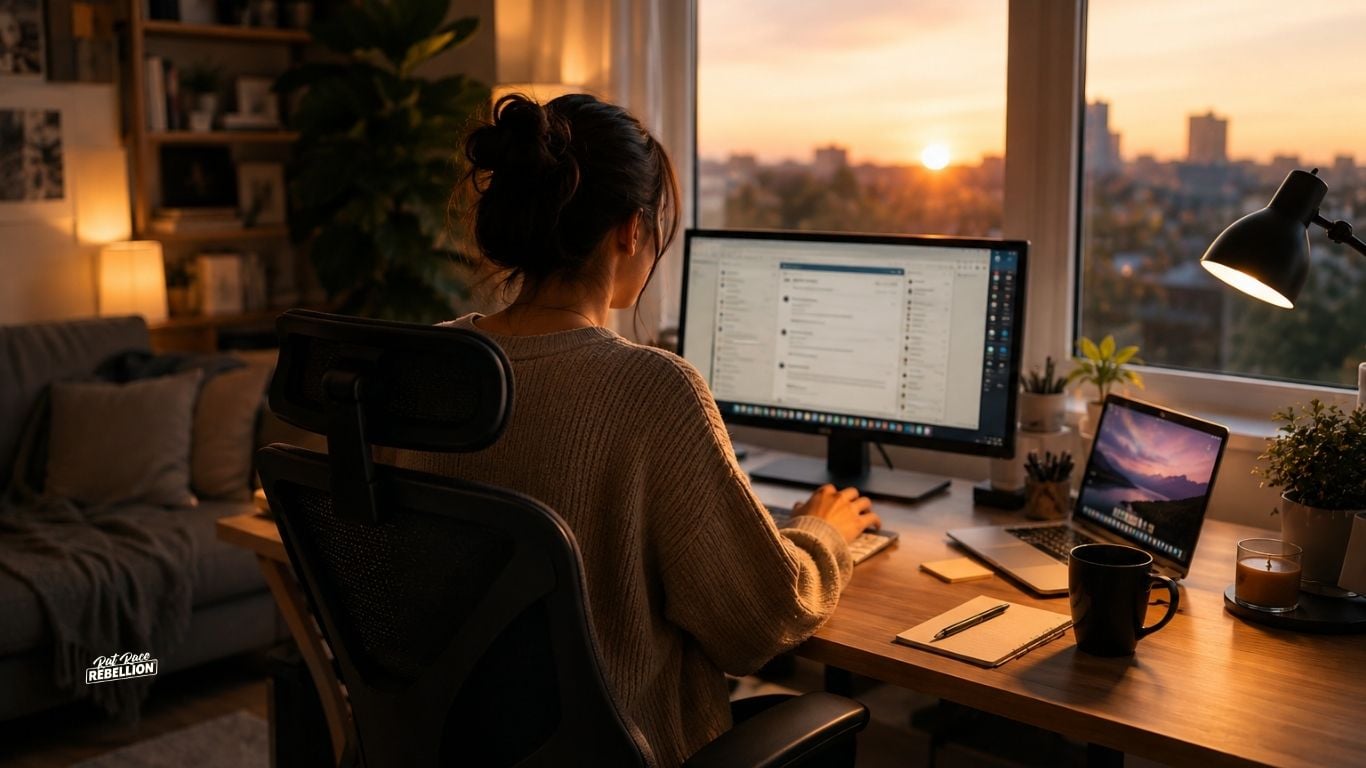
by Rat Race Rebellion July 12, 2026
Think about your last workday. What actually told your brain the day was over? Was it leaving a building – or just closing one browser tab before opening another?
For most remote workers, there’s no clear answer. And that’s a problem.
Remote work is supposed to give you your time back. No commute, no open-plan noise, no one stopping by your desk when you’re trying to focus. The promise is autonomy, and for many people it’s real. But research consistently shows that remote workers log longer hours and struggle more to disconnect after work – not because the work is inherently harder, but because something shifted that most people never noticed.
In an office, the structure of your day belonged to someone or something else — to the physical space, the schedule, the culture, the presence of other people packing up and heading home. For many remote workers, all of that transfers to the individual. The structure doesn’t disappear. Responsibility for creating it shifts from the workplace to you.
The Circuit Breakers Nobody Noticed
Office work had built-in recovery points that most people never paid attention to until they were gone.
The commute. The walk between meetings. The moment at the end of the day when you picked up your bag and left the building. None of these felt like meaningful breaks – they were just the friction of being somewhere in person. But that friction was doing something. It broke up the day, moved your body, and created transitions that told your brain when work started and when it stopped.
Remote work removed all of it. And most people didn’t replace any of it with anything deliberate.
The result is a workday with no natural edges. Email is available when you wake up. The laptop is there in the evening. Without a physical departure to mark the end, many remote workers simply never fully leave – not because they’re overcommitted, but because the cue to stop never arrives.
This is the thing that often gets missed in conversations about remote work and exhaustion. It isn’t really about time management or willpower. The workers who struggle most with remote work aren’t undisciplined – they’re just operating without a structure they didn’t know they were relying on.
What Sustainable Remote Workers Do Differently
The goal isn’t to recreate an office. It’s to recreate the transitions that helped separate work from the rest of your life.
The remote workers who hold up well over time aren’t necessarily more disciplined. They’ve figured out (sometimes on purpose, sometimes by trial and error) that they need to actively build what the office used to provide automatically. A few things show up consistently.
Recreate the transition, not just the clock. A hard stop at 6pm doesn’t do much on its own. What ends the workday isn’t the time — it’s a change in mode. A short walk, a different room, a specific routine that marks the shift. The signal doesn’t need to be dramatic. It needs to be consistent.
Make recovery look different from work. If you’ve spent eight hours looking at one screen, switching to another screen rarely feels restorative. The workers who end the day feeling genuinely recovered tend to build in time that’s physically or socially different from their work environment. Not just a different tab.
Treat your energy as part of the structure. The office gave your day a shape that naturally built in peaks and valleys. Remotely, you have to design that yourself. A remote worker who builds in a real lunch break, steps away from the screen mid-afternoon, and stops before focus completely disappears will usually have more left at the end of the day – not less.
Change something about your space when you stop. If your workspace and living space share the same room, your brain has no physical cue that work is over. Closing the laptop and putting it away, moving to a different seat, changing the lighting. The signal doesn’t need to be elaborate. It needs to exist.
The Bottom Line
Remote work doesn’t eliminate structure. It transfers responsibility for creating it from your employer to you. It’s a meaningful shift – one most job listings never mention, most onboarding programs never address, and most remote workers don’t recognize until they’re running on empty.
The flexibility is real. The autonomy is real. And so is the work of rebuilding what the office used to provide without you ever having to think about it.
The hardest part of working remotely isn’t the work. It’s learning to build the scaffolding the office used to provide automatically.
- How to Apply to 10 Remote Jobs a Week Without Losing Your Mind
- Company Guides
- Part-time Remote Jobs
- Side Gigs 2026


